


Dr. Eduardo García-Godos
Lic. Ana Sofía Del Solar
The year 2024 brought encouraging news for international trade, particularly due to the launch of the Port of Chancay and the forthcoming operations at the new Jorge Chávez International Airport. While the infrastructure gap remains significant, as recently stated by the Minister of Economy, these events received extensive attention during the APEC meetings.
Nonetheless, an efficient supply chain also requires optimized services and controls (on cargo and means of transportation) based on modern legislation and skilled human resources.
This article provides a brief overview of Peru's main progress and challenges in trade facilitation for 2025.

Following a 0.55% GDP contraction in 2023 (INEI, 2024), which marked the end of a decade of slow growth compared to the results achieved between 2004 and 2013 (World Bank, 2024), domestic GDP is expected to grow by 3.2% by the end of the year (BCRP, 2024).
Exports in 2024 reached USD 74 billion, recording a historic 14.6% growth compared to the previous year, driven by price increases in commodities, coffee, sidero-metallurgical products as well as higher sales of fish oil. Meanwhile, until October last year, imports increased by 2.6% due to higher purchases of consumer and capital goods (BCRP, 2024).
According to the 2023 Global Survey on Digital and Sustainable Trade Facilitation conducted by the UN every two years and based mainly on the WTO Trade Facilitation Agreement standards, Peru ranked second in the region with a score of 87.1%. This result surpasses both the regional average (71%) and the global average (69%), representing an improvement from its position in the 2021 survey (80.65%).
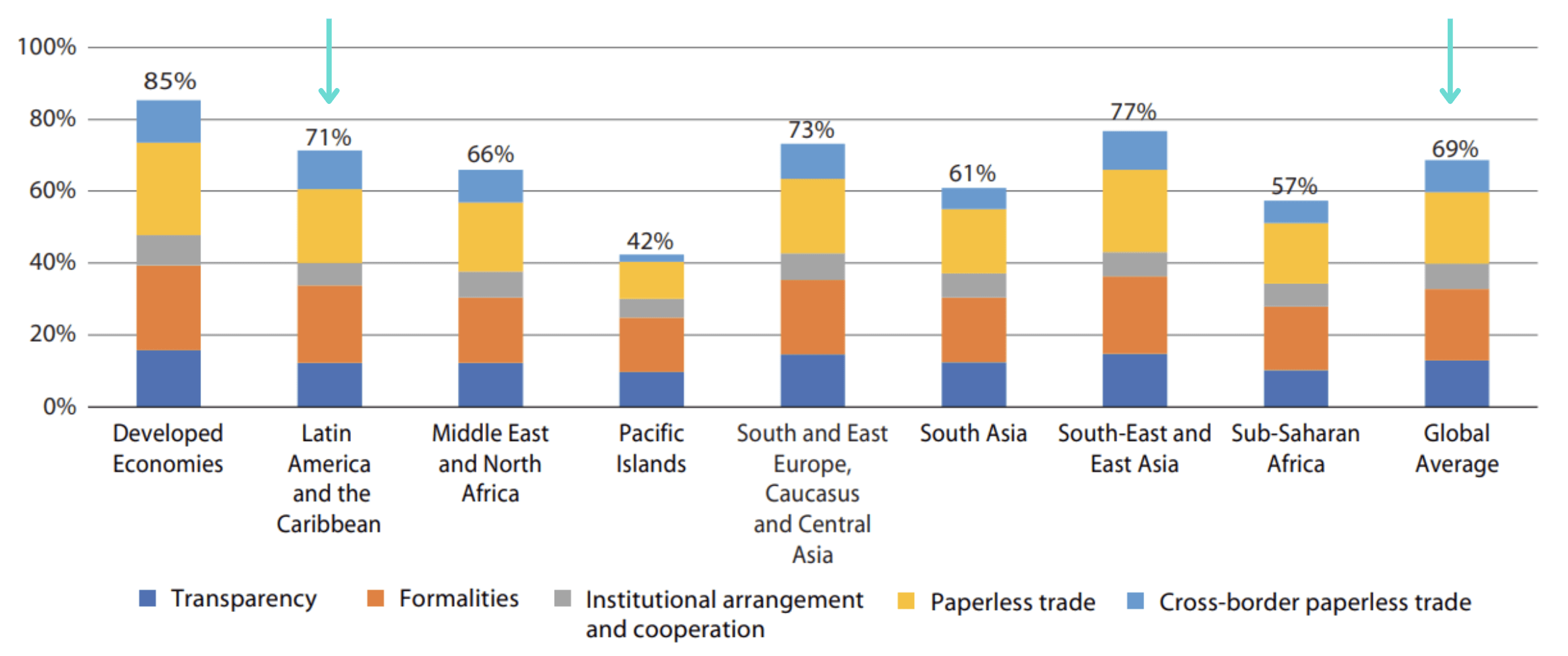
Source: Global Survey on Digital and Sustainable Trade Facilitation, 2023.
Among the indicators evaluated — transparency, formalities, cooperation and institutional agreements, paperless trade, and crossborder paperless trade — the country excelled in measures related to paperless trade, such as the performance of the Single Window for Foreign Trade (VUCE), the electronic submission of trade documents, and electronic payment of tariffs and taxes.
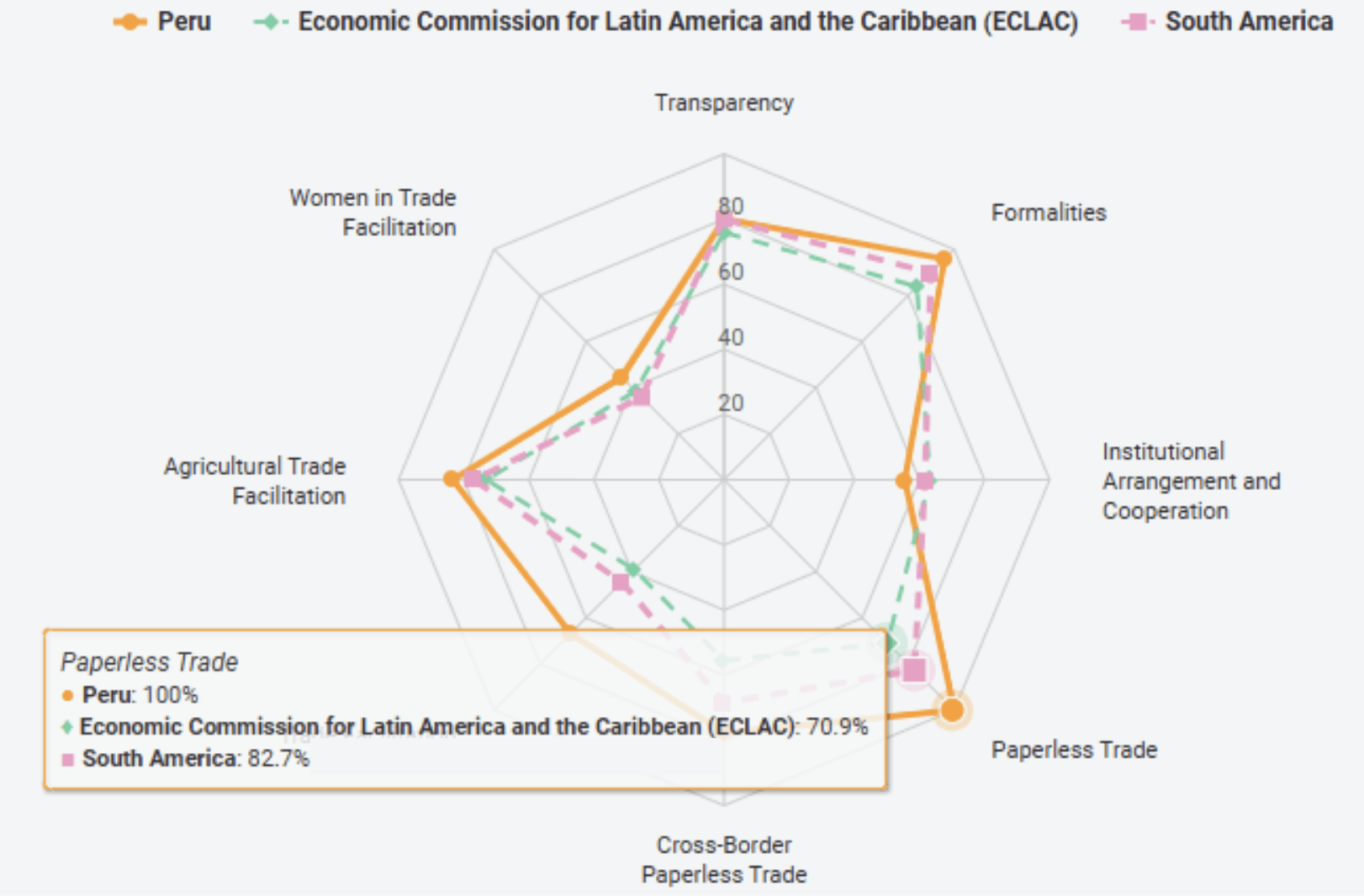
Source: Global Survey on Digital and Sustainable Trade Facilitation, 2023.
However, trade facilitation objectives and measures must go beyond those set out in the WTO Agreement. While the aforementioned survey embraces this vision, rapid technological advances and recent international agreements and standards gaining traction demand refining these objectives. It is required to thoroughly assess the impact of achieved measures using indicators for time, costs, and predictability, alongside setting new goals to leverage this juncture of greater international exposure.
The main public policy instruments related to trade facilitation include the National Export Strategic Plan 2025, the National Competitiveness and Productivity Plan 2019-2030, and the National Port Development Plan (PNDP).
To date, the trade facilitation "agenda" has been pragmatically managed through the Multisectoral Commission for Trade Facilitation (Comufal), led by the Ministry of Foreign Trade and Tourism (Mincetur).
The National Export Strategic Plan will expire this year. Trade facilitation goals are one of its pillars, with a series of objectives planned which have been addressed throughout these 10-years. However, the results have not been thoroughly examined.
It is urgent to review and update the trade facilitation pillar and link its implementation with Comufal's activities. This continuity would also provide markets with a signal of foreign trade policies’ stability.
The National Competitiveness and Productivity Plan, updated in October 2024, includes initiatives such as the SMART Borders model, the development of integrated non-intrusive information and control systems, the logistics facilities in Callao and Piura, and a nationwide network of truck centers. It also continues the Single Sanitary Inspector program, which, although remains and vanguard proposal, faces implementation challenges due to uneven operational capacities of the participating border controlling bodies.

The PNCP also aligns with the objectives of Mincetur's VUCE 2.0 Project, including the development of a Port Community System, the optimization of the Port Component and the Foreign Trade Logistics Observatory implementation (*). In line with the requirement to adopt the Maritime Single Window (IMO, 2024), the system's upgrading is underway and will be available by the first half of this year.
Last month, the updated National Port Development Plan was published. This instrument delves into projects such as the creation of Callao's pre-port area, the Port Component 2.0, and the Port Community System. Additionally, it anticipates the development of the River Port System and the Smart Ports Program.
However, it is crucial to integrate port operations with customs functions. Strategic lines on port competitiveness and efficiency, as well as port technology development, must follow the guidelines on cooperation between Customs and Port Authorities outlined by the WCO and the International Association of Ports (IAPH).
On past June, Law 32049 was enacted, amending Legislative Decree 1413. This law expanded the entities authorized to conduct maritime cabotage for passengers and cargo, allowing the participation of foreign shipping companies. The regulation, modified in December, established that cabotage obligations must be reported through the VUCE.

Additionally, in September, Law 32129 was passed, amending Law 30860, Single Window Optimization Act. This amendment broadened the scope of the so-called foreign trade community systems — previously limited to the maritime environment (Port Community System)—to include land and air supply chains, aiming to facilitate exchange of information among operators.
This regulation represents important progress in expanding trade facilitation for B2B transactions and multimodal transportation. The statute, currently under development, will specify the scope of these systems.

Moreover, the Special Economic Zones regime could undergo its most significant reform if the bill which permits private investment for exclusive operation is approved.

This project would particularly benefit the Port of Chancay, which has extensive adjacent space designated for hosting businesses that can benefit from the regime. While the proposed model is not ideal since each initiative would require approval through a specific law, pragmatic measures to attract private capital are essential for competing with trade partners that have similar models.
Digitalization of documents and data is significantly influencing crossborder trade and logistics. Disruptive technologies and generative AI are reshaping business models and, naturally, border controls.

As part of the activities of APEC’s Sub-Committee on Customs Procedures, a workshop on the Electronic Bill of Lading (e-BL) was held in August 2024. The workshop highlighted the conditions necessary for implementing the e-BL and the incentives for adopting the Model Law on Electronic Transferable Records (MLETR).
Later, in the APEC Leaders' Declaration, commitments were set out to promote trade facilitation through the digitalization of trade-related processes and documents. These commitments provide guidelines for promoting paperless trade systems, electronic authentication, and recognition of electronic trade documents, such as the e-BL and electronic invoices.
Coincidentally, in July 2024, the WTO announced that after five years of negotiations, a stabilized text of the E-Commerce Agreement had been finalized. Although not binding, its publication reflects the consensus of numerous trading partners.
The stabilized text includes key provisions such as the recognition of digital documents' validity, electronic authentication and signatures, data exchange, single window interoperability, consumer and data protection in digital environments, and cybersecurity measures. This agreement could likely serve as the precursor to the first global framework for cross-border digital trade.
A major milestone has been Peru’s application to join the Digital Economy Partnership Agreement (DEPA). Initially signed by Singapore, Chile, and New Zealand, and expanded to include South Korea in 2024, DEPA promotes digital transformation and the publication of trade forms and documents in electronic formats, recognizing their legal validity.
It also fosters single window interoperability, electronic invoicing systems, and AI within a reliable, secure, and responsible framework.
This agreement complements and deepens existing provisions on interoperability and digitalization established in the Pacific Alliance.
Moreover, DEPA members are committed to adopting legal frameworks aligned with international standards, such as UNCITRAL's Model Law on Electronic Commerce and the United Nations Convention on Electronic Communications. They also encourage adopting the MLETR to provide legal certainty regarding the validity of electronic transferable records, such as the Bill of Lading.
Last year, the International Chamber of Commerce (ICC), through its Digital Standards Initiative (DSI), published an important document for trade facilitation.
Titled "Key Trade Documents and Data Elements" (KTDDE), it builds upon two previous reports and the "Paperless Trade Cross-Border Toolkit," developed in collaboration with the WTO, UNCITRAL and ESCAP.
According to the KTDDE, 58% of the reviewed trade documents have standardized electronic versions, 16% are subject to multiple digitalization standards, and 25% remain in the initial stages of standard development.
This report analyzes 36 essential documents used in cross-border trade of goods and explores data standards within supply chains to establish a framework for trade digitization.
It offers recommendations for standardizing and digitalizing supply chains, emphasizing the use of existing standards for private transactions related to cargo content, characteristics, and international transportation services.
The KTDDE significantly reinforces a “whole-ofgovernment” approach to trade facilitation. Its recommendations should be incorporated into the national agenda, either through a new National Export Strategic Plan or as part of Comufal's initiatives.